
Monday, September 10, 2012
Grafting Wtih Graeme George

Farm Stay at David Arnold's Murnong Permaculture Property

Friday, June 8, 2012
Change
New designs have been drawn up... the Tree Surgeon has visited and this long weekend transplanting will begin to make way for the new landscape design.
The last 2 months has seen a huge amount of clearing, weeding, newspaper, weedmat and mulching and now its time to get preparation in progress for Spring.
This past 5 months have been spent either in Ballarat starting the Permaculture Design Course or in the Garden. I am both inspired and exhausted.
The more I learn - the more time I want to dedicate to the process of engaging in the environment and learning from Nature.
A report and overview of progress thus far to follow.
Thursday, February 16, 2012
Retrofitting the Burbs
I had the chance today to sit in on David Holmgren's Retrofitting the Suburbs for Sustainability at The Wheeler Centre.
It was very timely. Getting into work - a colleague spoke about how crazy the amount of time it took him to commute into the City given that he lived just North/West of the CBD. We had both experienced not being able to board 2 trains/trams simply because we couldn't fit in!!
As I took the tram up Swanston St and compared the volume of foot traffic to when I was studying in the city 10 years ago ... it feels as though it has doubled.
With what David describes as our Energy Descent Future and the subsequent reduced mobility of people and goods - moving either closer to the city or re-locating to a job closer to home is already looking like an appealing option.
At the moment riding my bike is an option - but even along Swanston St - with the new MEGA Tram Stops (no more Trams actually servicing these stops) the bike riders are currently battling with pedestrians and tram, so bridging the South Side of Melbourne has become ever more of a challenge for our warriors on 2 wheels.
But above the doom and gloom David's talk was humorous and engaging. I live in a street very much like the one he described in his talk on 'Aussie St' - a neighbourhood of four houses battling to come to terms with a failing economy and energy crisis. What rang true for me out of this talk - was how much richer in community we can potentially become. Choosing your neighbours wisely in this scenario was critical. I see the 'incremental adaption' that David described already emerging. I run a small business - using recycled material - not only because I love the vintage look - but because having worked for a multi-national fabric company - I know the extent of price exploitation on imported fabrics. I am also aware of the social and environmental impact fabric manufacturing has on our Asian neighbours - where most imported fabrics are sourced. I see the increments becoming leaps and bounds before we know it. Its not only a rather confronting time to be alive - but if you are willing to move out of old habits - its a really very exciting time - to watch and see - can our innovation overcome our fears.
Thursday, November 3, 2011
Tuesday, October 18, 2011
Nepal’s Stolen Children: A CNN Freedom Project Documentary
I had the chance this week to attend the screening of CNN's launch of the Freedom Project which features Demi Moore in Nepal addressing the epidemic issue of human trafficing.
The panel discussed this issue closer to home in Australia.
The arguments went around in circle - how do you modify this trend? Whose responsiblity is it? What are the avenues of communication?
The core issue was gleaned - but not emphasised. The catalyst for human slavery is poverty. You can not stop slavery without removing the desperation of those forced or trapped into it.
The Fair Trade brand was represented and it was this spokesperson who called a spade a spade. To stop global poverty we have to buy Australian Made. That means having less - and paying more. Needless to say if this became a reality he would be out of a job!
There is a silent collusion on the part of every consumer to turn a blind eye to that which we support through our purchasing. It is a cultural addiction. If we could kick it - we wouldn't recognise the world we live in.
The CNN Freedom Project
Maiti Nepal
Tuesday, October 11, 2011
Spain 3
Reasons why I love Spain / Portugal:
1) They allow weeds to grow in the gutters and become a thing of beauty
2) They have a road of telephone poles called crane city
3) They grow orange trees in the Street!! (seville)
3) They have ancient viaduct systems in their temples that feed the trees and trip up the tourists


1) They allow weeds to grow in the gutters and become a thing of beauty
2) They have a road of telephone poles called crane city
3) They grow orange trees in the Street!! (seville)
3) They have ancient viaduct systems in their temples that feed the trees and trip up the tourists


Monday, October 10, 2011
Spain 2
Back to Spain as Summer in Melbourne still eludes us ....
Oporto is famous for Port and for Cork!
At the Graham's Port distillery the depiction of the vineyard in cork had me very excited about ways of planing out the lay of land in hilly areas.
Oporto itself is a city build layer upon layer and the use of space through layering was used across the Spanish landscape.


For certain, the most extreme example of building on a steep incline is Montserrat:


And this... some Ancient Ruins near Toledo

Saturday, October 8, 2011
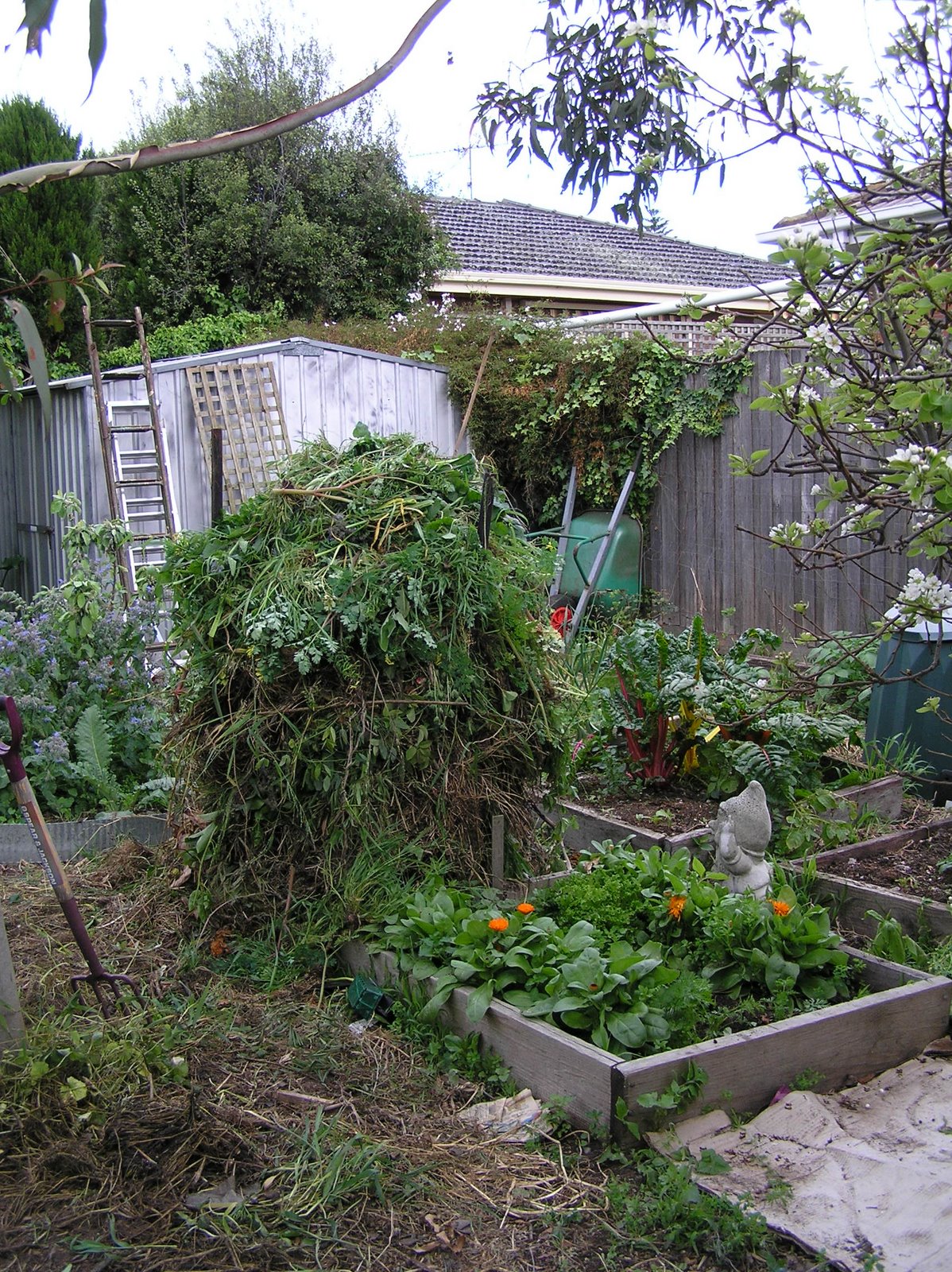
The easiest Compost Pile Technique
I saw this technique on gardening Australia.
Two stakes - either side, and alternate dry / wet piled high. I supported the pile by putting a narrow baboo stake through the centre.
I added thistle and comfrey to assist the break down.
Lets see... time will tell!

Two stakes - either side, and alternate dry / wet piled high. I supported the pile by putting a narrow baboo stake through the centre.
I added thistle and comfrey to assist the break down.
Lets see... time will tell!
Cauliflower
About three weeks ago I was weeding around the plum and thought what a shame that the Cabbages I had planted beneath had bolted. My efficient-self was eager to pull them out and add them to the compost bin. Another quiter-self said, not now. Lucky they didn't get the yank... as I got a fabulous fright to see two big white Cauliflower faces smiling up at me - seemingly sprouting over night.
I harvested them today and not a bug in sight!
Curried Cauliflower for dinner!


I harvested them today and not a bug in sight!
Curried Cauliflower for dinner!


Wednesday, October 5, 2011
Linda Eldredge on Radio National
Today while listening to the bush Telegraph on Radio National - Linda Eldredge's description of working the land while referencing her apps via her iphone and making the paddock her office got the host and in turn myself very excited.
Although determined not to be online 24/7 and therefore holding off the temptations from my phone company to sign up for an iphone, this interview conjured in me some practical uses for Permaculture Design.
For example. Being able to assess a remote property - anywhere on the globe in fact and reporting back a Permculutre design with the aid of video footage.
Also an accurate assessment of lay of the land, climate patterns and topography, while walking the land with a client.
I think it is early days - this interview will provide some inspiration for those (like myself) who are tech wary!
From the kitchen table to the tablet, Nuffield scholar researches real-time technology - Bush Telegraph - ABC Rural (Australian Broadcasting Corporation)
Tuesday, October 4, 2011
PDC 2012
This blog started with the intention to implement a Permaculture Design into the Miyoga Garden.
2 years and 100 posts later... I have enrolled in the Course!
In the meantime more observations and helpful hints to come... including not throwing out what appears to be a bolted cabbage because it just might turn out to be a most beeeautiful head of cauliflower! What a great suprise I got today.

2 years and 100 posts later... I have enrolled in the Course!
In the meantime more observations and helpful hints to come... including not throwing out what appears to be a bolted cabbage because it just might turn out to be a most beeeautiful head of cauliflower! What a great suprise I got today.

Sunday, October 2, 2011
Grafting Success

Its been just about a month and the grafting has been a success.
The objective for grafting came after a visit to Mama Longo's garden last year. She wanted to have a graft of the plum tree we have here at the Miyoga Garden.
Unfortunately by the time the grafting workshop at BAAG was organised it was too late to graft Plums. Also Mama Longo didn't have a plum so we have this weekend planted one ready to graft next year!
Some tips for Grafting sucess:
In the Southern Hemisphere July - August is the grafting season. When the sap is rising, the tree must be growing, not dormant, but also not flowering.
Drop flowers off below the graft as you don't want them taking precious moisture away from the area.
For Soft Wood a cleft graft is recommended - for other woods a tongue and whip
Keep your grafting knife sterilised with a jar of 1/2 metho and 1/2 water - this is also a good practice for your pruning tools.
Dwarfing trees is made possible by intersecting a species with a segment of a dwarf stock. For example a Pear tree - grafted with a dwarf apple - followed once again by the pear species.
Use small plastic bags to seal the graft and keep moisture in - however watch the temperature on the day.
If you are north facing - then make the graft on the south side of the plant - so that it won't be dried out too quickly.
Always remove buds off the root stock - otherwise it will take over.
Who goes with whom?
Apricot go with Plum
Citrus go with Citrus
Apple go with Pear
Quince go with Pear
Persimon go with Persimon
Plums go with Plums
Apples go with Apples
Nectarines go with peaches
Figs on with Loquot
Benefits of grafting include choosing root stock that is suitable to your land and conditions. For example if you are flood prone then you can grow on root stock that tolerates a wet soil and graft an apple that normally wouldn't survive these conditions.
It also assists in cross pollination and allows for a longer fruiting season. Ideally you could have an apple tree that provides fruit all year round! A challenge.
Tuesday, August 23, 2011
Grafting Workshop
Well this weekend I put a Doc Hog onto a Granny Smith. Sounds like the promo of a British Crime TV series. But no, I was grafting. Having learned the basics with Neil last year at the Toora Heritage Pear and Apple Farm it was time to weild a grafting knife myself. The workshop was organised by Buleen Art and Garden. The more that I learn about grafting - the more there is to learn. Well that's the same as gardening in general isn't it.
After the workshop a visit to BAAG followed where I discovered a native plum which is home in the Australian Rainforest. I would have liked to experiment a bit with this one to see if a European plum would take to it - however am not confident that the climate in Melbourne will sustain the rainforest plum - perhaps when I get my hot house the experiment can ensue!
For Mama Longo I am swapping her my new grafting skills for some Recipes. I think I get the better end of the deal!
Thursday, August 11, 2011
Consensus, Community and Addiction
This is a timely article in light of the London Riots, Carbon Tax - pick your issue ... Consensus, Community and Addiction
Wednesday, August 10, 2011
Winter 2011


Last Days of Winter! This week I have potted up some Raspberry sticks - and got a bit ambitious and a wee bit eager for Spring/Summer by purchasing some Eggplant Seedlings - but just couldn't resist.
The Kale seeds from last year have produced some hardy little seedlings. I'm hoping they don't bolt too quickly as the warm weather approaches.
The first asparagus appeared under the gaze of Mary! I will plant some more to bunch the patch up and get some product in the next 2-3 years.
Thanks to Joe's assistance the back fence is looking truly loved. Grape vine, and lemon have been cleared of Jasmine and the Olive given a Prune after picking.
Bring on Spring!


Wednesday, July 27, 2011

Thursday, July 14, 2011
Thursday, July 7, 2011
Soylent Green
An interval from Spain for a moment to review the Sci-Fi Classic Soylent Green.
This movie came to my attention in an introduction by Thomas Fischbacher for the transcript of Bill Mollison's PDC Course (see below).
Set in 2022 and made in 1973 it got me thinking about our own 50 year vision. What do we imagine the year 2061 will look like? And will we be eating each other in the form of Soylent Green??
Actually I didn't expect to enjoy this film... I mentioned it to a friend who went to the bother to find it ... rather than discover it in the Sci-Fi section the video guy lead him to the 'Stoner' section. Ah Bill what path are you leading me up????
But it had me hooked. And made me appreciate the home cooked meal in front of me. Even though futuristic, this film has a great retro aesthetic - I particularly appreciated the vision of video games in the future - little did they know that Star Ship troopers would have revival in its retro form!
I imagine at the time Permaculture was conceived of these were the topical issues (not star ship troopers but the death of the ocean, over-population, climate change) and they remain pertinent today.
I really appreciated the character of Sol - who spoke of the past (life as we know it) and admitted I could have done more -- I should have done more. I think perhaps he speaks for us today - who know all the facts and have this window of opportunity to create change.
3 and 1/2 stars
A good Sunday arvo watch on a rainy day - so long as your mood is up beat !
http://www.imdb.com/title/tt0070723/
"if we take a close look at our history, the evidence that it by and large manages quite well to explain a large number of observations (such as the collapse of many past civilizations) should give us more than enough reason to stop for a moment and give it some thought. If this is what we really do - wouldn't that mean that, if we continue like this, then in all likelihood we would ultimately end up being driven to eat the grass and the earthworms from the soil for there is nothing else left which we have not destroyed before? Art has raised this question many times. This is, for example, the topic of the science fiction movie "Soylent Green".
When we get confronted with such an idea, how do we deal with it? In our western society, there seem to be two widespread reactions to it: The maybe less common one is "the environmentalist's" of considering this as our inevitable fate, with the only relevant question being whether we can slow down the inevitable degradation enough to retain a reasonable quality of living for the next few generations by curtailing our own exploitation in order to leave something for them to exploit. (Is it inappropriate to associate this thinking to "environmentalists" as strongly as this use of that term in the previous sentence seems to indicate? Most likely so. Still, quite a number of people have views which at least broadly match this concept.) The presently dominant reaction is "the economist's" of coming up with rational-sounding excuses based on the idea that "our cleverness always found a solution, and always will" - a comforting idea which we all perhaps would like to believe, but which undeniably quite strongly smells of human-ego-off-its-rocker-again, and doesn't actually fare well when confronted with the evidence. Essentially, this is little more but a thinly disguised head-in-the-sand attitude.i> " (Fischbacher. T., http://www.soton.ac.uk/~doctom/teaching/permaculture/PDC/index.html)
Subscribe to:
Posts (Atom)